Collagen is Like Chicken Wire??? On the NYT Interstitium Article
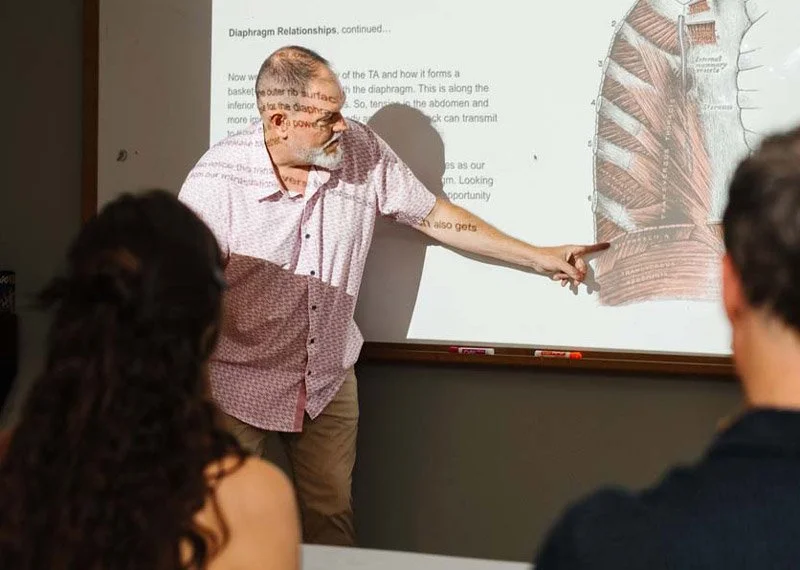
Michael McMahon teaching a class on the diaphragm.
On Monday morning at dawn my phone started pinging. Colleagues, students and patients were sending me the NYT article on the Interstitium. It is undeniably exciting for our shared fields of study and practice when this content emerges into the mainstream as represented by the NYT. And, also problematic.
The article presents us with a dilemma, especially for those of us who have been working within and studying fascial properties and/or East Asian medicine. Both fields of inquiry have been traversing this terrain in different ways for various lengths of time. Despite what the article repeatedly references, the interstitium and its properties are not “newly discovered”. The interstitium and its intrinsic properties have always been there and have been well articulated and used within a framework of medicine by other traditions for thousands of years.
When working from within the western tradition -- which has a history of occupying both physical and conceptual terrain that others already inhabit -- invoking discovery tropes is undeniably problematic. Ideas of the interstitium are embedded in East Asian medicine theory and practice dating back to the ~4th century CE and recorded in the Chinese medical classic, Huangdi Neijing (The Yellow Emperor's Classic of Medicine). The Nanjing (The Classic of Difficult Issues), written around the 2nd century CE and quoted here from Kiko Matsumoto’s Reflections on the Sea (1988) states:
“Huang is the space between the organs, bones, and flesh. It is that through which the yang qi streams.” Matsumuto, continues: “In this context, where ‘huang’ is already understood to mean 'fat, greasy tissues or membranes', it is most reasonable to consider this a reference to insubstantial membranes or fasciae that line and lie between the organs, bones, and muscles.”
The Chinese medical classics are verified repeatedly over thousands of years of clinical practice and conceptual theory; they contain well-established and articulated ideas that are almost exactly the same as the “newly discovered” interstitium as presented in the NYT article.
The article obliquely references this historicity as opposed to leading with something like, "Western science is finally catching up to ideas about the body that have been understood and practiced by East Asian medicine for thousands of years." This would place the research within a broader global knowledge base that has been mapping these ideas by different names for millennia. Context matters.
I find the article to be littered with clumsy, misleading and straight up false metaphors. The central implication of the interstitium is that there now exists western science evidence for a continuous fascial weave that potentially links the various systems of the body. Western science has a long standing preference to see these systems as discrete and whatever fills the spaces between them as irrelevant - despite the well known ideas presented above from East Asian medicine.
Fascia and fascial properties are what make this current research compelling. And then the author make a simplistic and flat-out incorrect analogy, "Collagen is like chicken wire". I can't. Collagen is the main protein that comprises fascia. It is a triple helix and if, as the article later explores, the interstitium is where we might find the conductive properties of a meridian, it is because of what happens at the interface of the triple helix collagen fibril and how it structures living water. Dr. Mae Wan Ho spent a career researching this idea and it is well published, including her book, The Rainbow and the Worm. Dr. Ho wrote in an article published in 1989:
“We propose that the acupuncture system and the DC body field detected by western scientists both inhere in the continuum of liquid crystalline collagen fibers that make up the bulk of the connective tissues. Bound water layers on the collagen fibers provide proton conduction pathways for rapid intercommunication throughout the body, enabling the organism to function as a coherent whole."
I don't think Dr. Ho and her co-authors would find any coherence in the chicken wire metaphor. It is not a capable comparison for describing the interstitum's potential for the energetic properties of acupuncture meridians that are later referenced.
The NYT article author clearly has a materialist bias, which leaves them ill equipped to handle the research and its East Asian medical implications.
The article states: "The workings of the cardiovascular system, in which the heart pumps blood through arteries, capillaries and veins, were first described in 1628 by the English physician and anatomist William Harvey." This is an outdated machine-based concept of how the heart works
I recently had the honor of reading an incredible capstone project by Aspen Devillier, a former student of mine, which cites ample current research that the heart is NOT a pump. Devillier writes:
"The heart is shaped specifically to generate vortices. There are three major fiber orientation layers of the heart, all of them continuous and can be unwrapped by hand without instruments. There is an outer left-handed helix, the middle circumferential, and the inner right-handed helix. This creates the double helix, or the opposing spirals. During contraction the base rotates in one direction and the apex rotates opposite. This twisting motion, like wringing out a towel, is called torsion."
The conclusion is that this contractile torsion spirals the blood, giving it its motive energy.
Western science struggles to see past what it has already decided to be true; it becomes beholden to its previous modeling, forgetting that the model is just a story about how things might be, not a declarative fact about how or what things are. An author in 2026 quotes a scientist from 1623 rather than more current findings that are different than the conventional model.
Clumsy and incoherent metaphors belie western science’s difficulties in reckoning with ideas that contradict its previous models. Metaphor is a potent linguistic and conceptual frame and should be used thoughtfully and skillfully. The NYT unfortunately shapes how folks think. Now we have people encountering beautiful research amidst misleading and ridiculous metaphors (I didn't even address that "fascia is like studs in a house") and absent robust treatment of historical and cultural contexts.
The body is non-conformist and thus will show categorization to never quite fit its shapes and ways. Like a river meanders, the body is a shape-shifter. If the desire is truly to learn, then at this juncture in human history, there is enough evidence at hand to actively choose to be multi-epistemological than to use an epistemological monocle and only see a singular perspective. The western “scientific method” is only one way of knowing among many. A way of knowing that can be both revealing and potentially obscuring depending on how it is communicated and framed.
Check out some related articles: